
Mud and soft ground
Send photos and a short safe video of the wheels and the route from firm ground so a suitable pull-out can be assessed.
Baloch Recovery Services · Pontefract
Stuck on a soft verge, in mud or against a ditch bank around Pontefract? Baloch Recovery Services assesses pull-out enquiries using your vehicle details, exact location and safe scene images, with the method and access considered before a truck is dispatched.
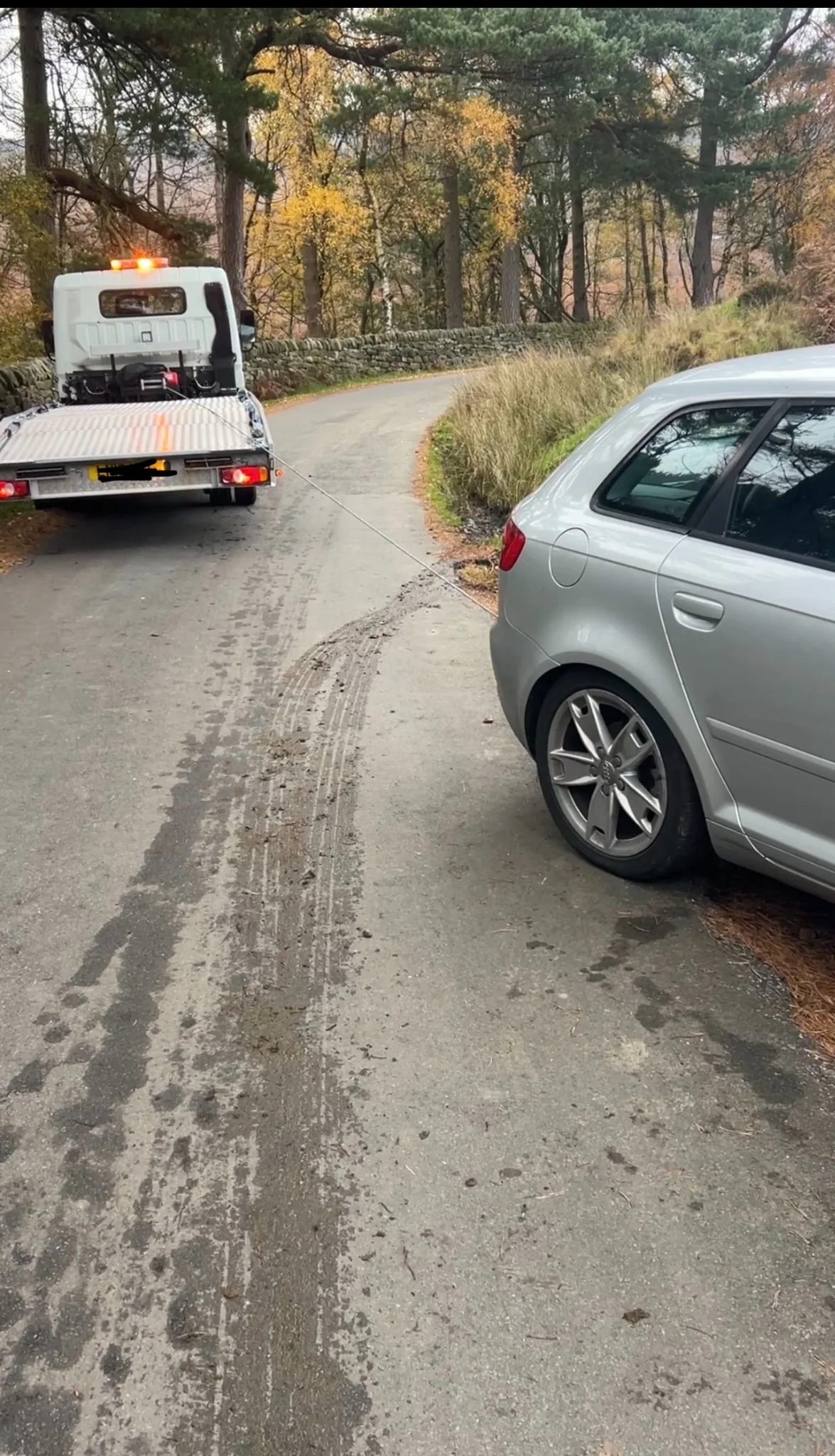
Pontefract pull-out enquiries
A car can become stranded without being far from the road. One side may have slipped onto a soft verge, a turning manoeuvre may have put the driven wheels into mud, or a parking space may have proved softer than it looked. Tell Baloch Recovery Services what happened and how the vehicle is now sitting. That information helps establish whether a controlled pull-out is a suitable way to recover it.
There is an important difference between a vehicle standing upright on level grass and one resting against a bank or partly in a ditch. A tyre hidden in mud, a wheel at an unusual angle or a body panel touching the ground can change the equipment and working space needed. Please describe those details even if the vehicle still starts. Engine operation alone does not show that it can be recovered or driven safely.
Enquiries are welcome 24/7, and you can request a no-obligation quote using the “Ditch pull-out” option. Supply your precise location, vehicle details, safe photographs and a short video showing the scene and access. If recording would expose you to traffic or unstable ground, explain that instead. The assessment must account for the information available, and any further inspection or revised arrangements should be discussed before work proceeds.
Send photos and a short safe video of the wheels and the route from firm ground so a suitable pull-out can be assessed.
Show the vehicle position and surrounding access. The recovery plan depends on stability, damage and the space available.
Tell us how close the vehicle is to traffic and which wheels are stuck, locked or damaged.
Local roads and access
Pontefract sits close to major through routes as well as residential streets, commercial premises and rural approaches. The place name alone rarely identifies where a recovery vehicle can stand. Include the road, direction of travel and the entrance that actually leads to you; a postcode may cover several buildings or a long stretch of access road.
The A639 corridor connects the Pontefract area with Glasshoughton and Castleford, while the A645 includes Southgate in Pontefract. These road names are useful starting points, but a verge beside a main route and a muddy entrance reached from a side street are different recovery situations. Add the nearest signed road, business entrance or recognisable junction, together with a map pin at the stranded vehicle.
For a vehicle behind premises or inside a car park, identify the customer, service or delivery entrance that should be used. Mention barriers, access codes and restricted opening arrangements. A route that was open when you arrived may not be available to a truck later, so arrange access with the person responsible where possible.
On the M62 or A1(M), report the carriageway and direction, the last junction or sign you can identify safely, and any location marker already visible. Never walk along the carriageway to obtain a better description. A map pin can help locate the incident but does not by itself establish a lawful, safe route to it.
If the vehicle is on a local road near a motorway, make that distinction clear. “Near the M62” could mean a public road, an industrial estate or a private track with no access from the motorway. Your enquiry should describe the road you are physically on and the approach you used.
Enquiries can also be assessed for Castleford, Featherstone, Knottingley and nearby places. Give the actual location rather than selecting Pontefract simply because it is the best-known town nearby. For a farm, yard or field entrance, include the final turning and whether there is a firm stopping area before the soft section. Coverage, vehicle suitability and availability are confirmed for the particular job.
If your vehicle needs onward transport after a pull-out, or has broken down on a firm surface, these local recovery pages explain the available services. Include any onward destination when requesting your quote.
Soft-ground assessment
A grass verge can look usable while the soil beneath it has little support. Mud may also be limited to the entrance of an otherwise firm driveway or yard. Explain which wheels are affected, whether the ground slopes and how far the vehicle is from a sound surface. If you already know that a drainage channel, kerb or rut lies underneath, mention it; do not probe the ground or crawl beneath the vehicle to investigate.
Repeated attempts to accelerate out can deepen ruts or move the vehicle into a less stable position. Once it is clear that normal movement is not working, stop trying and report the situation. Please tell us about any attempts already made, including whether the vehicle has moved sideways or settled lower. Those observations are useful even if there is no obvious damage.
The short scene video should show the relationship between the vehicle, the soft ground and the available approach. Film from a safe place you can already reach. Include the width of the entrance, any gate and the nearest firm area if they are visible without walking into traffic. Several close photographs of a buried tyre are less useful without a wider view explaining where a recovery truck might work.
For private grass, landscaped ground or a field entrance, tell us who owns or manages the land and whether permission to enter is available. A pull-out may disturb already damaged ground. Access permission and a sensible working position need to be considered alongside recovering the vehicle, particularly where a narrow entrance or a soft track could also leave the attending truck without support.
Ditches, banks and uneven verges
Use the “Ditch pull-out” enquiry option whether the vehicle is in a drainage ditch, down a shallow bank or caught against a verge edge. Describe the depth as best you can from a safe viewpoint, which side is lower and whether the vehicle is leaning. Do not climb down beside it to measure the ditch or retrieve an item. A change in weight or ground support could affect its position.
Tell us what the vehicle appears to be resting on: its tyres, underside, a bank, a kerb or something you cannot see clearly. If there is water, explain what you can observe and whether it is rising. Photographs cannot always establish what is supporting the vehicle, so a final method may depend on inspection at the scene. Water, a severe lean or extensive damage may require arrangements beyond a straightforward winch pull.
Access matters on both sides of the incident. A suitable truck needs a safe working position, and the vehicle needs somewhere appropriate to finish the recovery. A narrow lane with a blind bend, traffic passing close by or an unstable edge may prevent work starting until the location can be managed safely. Please describe those constraints in the enquiry rather than assuming the distance to the road makes the job simple.
Do not attach ropes, chains or another vehicle to improvise a recovery. Keep people away from the stranded vehicle and any recovery equipment. The attending operator will determine the equipment, attachment arrangements and exclusion area appropriate to the vehicle and conditions.
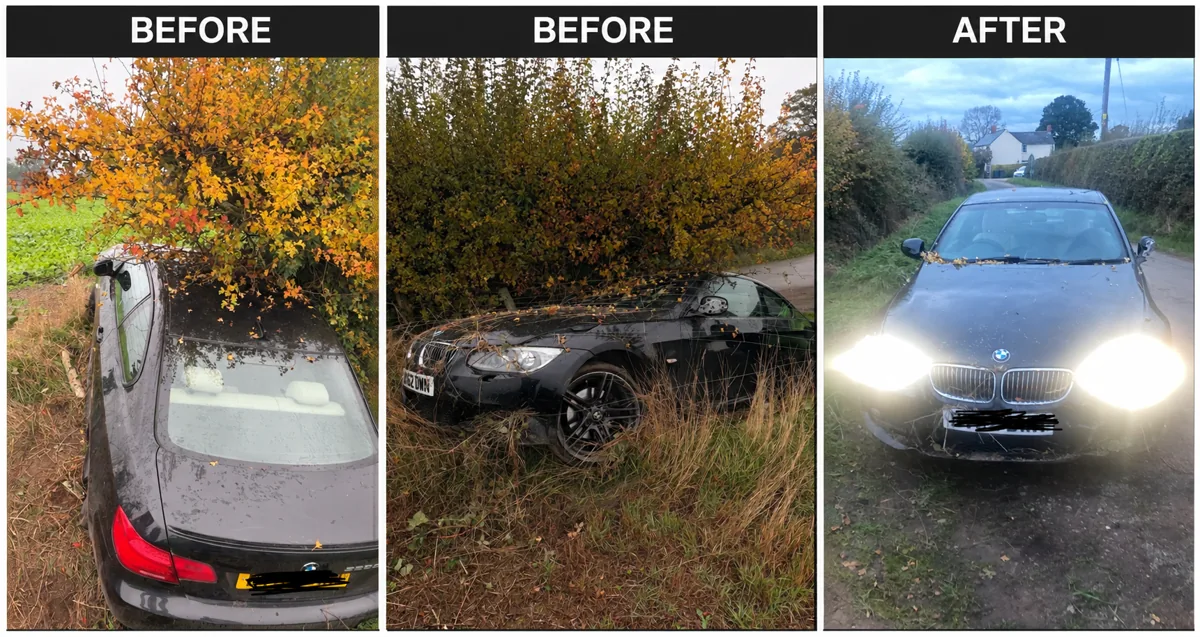
An existing recovery example. Send photos and a short safe video of your own vehicle and access so we can assess your request.
Vehicle suitability
Cars, SUVs and suitable vans can be considered for a Pontefract pull-out. Suitability depends on the individual vehicle, its position, its condition and the access available. Please provide the make, model and any relevant modification or unusually low clearance; a vehicle description such as “small car” leaves important questions unanswered.
An SUV's ground clearance does not establish a suitable recovery method, and four-wheel drive does not remove the need to assess traction, stability and damage. Explain whether the vehicle can select neutral, whether the parking brake releases and whether the wheels can roll. Only report what you already know or can check safely; do not make the vehicle move to demonstrate it.
For an electric, hybrid or automatic vehicle, identify the model and any loss of electrical power or transmission warning. Manufacturer requirements can affect how it is recovered and transported. Tell us if a wheel is locked, steering is restricted or the underbody has struck something. Those details may change whether the vehicle can be repositioned or needs transport afterwards.
For a van, provide its type, approximate size and the load it is carrying. A loaded van or Luton requires a weight and access check before a suitable truck and method can be confirmed. Include an estimated load description rather than omitting it because the items are out of sight.
A high body, long overhang or conversion can also restrict the available route or affect stability on a slope. Mention roof equipment, a trailer or an unusually long wheelbase. Do not unload a leaning vehicle or enter its load space to collect information. If the weight or configuration is uncertain, say so and let that uncertainty be included in the assessment.
Your pull-out enquiry
Choose “Ditch pull-out” on the quote form and put the most important facts together in one message. A complete enquiry helps avoid delays caused by asking separately for location, vehicle condition and access. The details below apply whether you are on the edge of Pontefract or at premises in one of the surrounding towns.
Booking and arrival
After reviewing the enquiry, Baloch Recovery Services can discuss the available recovery approach and a no-obligation quote. Further questions may be needed if the images do not show the full scene or the vehicle details are uncertain. Tell us about anything that changes while you wait, such as the vehicle sinking further, an entrance being locked or traffic making the location harder to reach.
The response aim is around five minutes for a complete enquiry, although busy periods can take longer. That is an enquiry response aim, not a promise that a truck is already travelling. A clear video and the requested information help the team assess the circumstances, but do not replace checks required for a difficult position or heavier vehicle.
Arrival within around 30 minutes is an aim only when a suitable truck is nearby and available. The ETA is confirmed for your booking and depends on the vehicle, location, access and existing commitments. A truck's proximity is only useful if it can carry out the particular recovery safely. Ask for the confirmed timing when the proposed arrangements are explained.
A deposit is required before dispatch, with the remaining balance payable on completion. Confirm the agreed scope, payment arrangements and any onward transport before paying. If you need help for passengers, mention this at booking: one or two passengers may be accommodated only when the assigned truck has suitable available seats.
Price and scope
A pull-out price depends on the work required, not just the distance from Pontefract town centre. A car upright beside firm hardstanding presents different requirements from a loaded van against a ditch bank or a vehicle with a locked wheel. The quote needs to account for suitable equipment, the working position and the route out of the soft ground.
The condition of the approach can be as significant as the stranded vehicle itself. A truck may not be able to use a weak verge or cross a soft field to reach it. Narrow gates, sharp turns, low branches and restricted space can affect what equipment is suitable and whether additional arrangements are necessary. Describe known restrictions early so the quote reflects the real site.
Confirm whether the proposed price covers only recovering the vehicle to firm ground or also transporting it to a garage, home or another agreed destination. If the vehicle's condition changes the plan once inspected, the revised work and cost should be explained before proceeding. A no-obligation quote lets you understand the proposed scope without assuming every incident fits one fixed service.
Keep the booking details available so the agreed location, vehicle and destination are clear. Accurate information about a van's load or a hidden access restriction is more helpful than describing the situation as a “quick pull”, which does not establish the equipment or time needed.
While you wait
If anyone is injured or there is immediate danger, call 999. A vehicle stranded in a live traffic lane, becoming unstable or exposed to an immediate collision risk needs urgent attention. A recovery enquiry is not a substitute for emergency help, and you should follow instructions from the emergency services where they are involved.
On a motorway or other fast road, leave the vehicle only if it is safe to do so. Exit away from passing traffic and move to relative safety, away from the vehicle and the carriageway. If it is unsafe to exit, stay inside with seat belts fastened, switch on the hazard lights and call 999. Do not stand next to the vehicle to film traffic or inspect a wheel.
On quieter roads and private land, traffic may be less obvious but a ditch edge, wet bank or leaning vehicle can still be hazardous. Keep children, passengers and pets away from the recovery area. Do not wait downhill from an unstable vehicle or assume a bank is firm because its surface is grassy. Choose a position from which you do not need to cross the working area when help arrives.
Take photographs and the short video only if you can do so safely. If darkness, weather, passing traffic or the vehicle's position makes recording unsafe, explain why it is unavailable. Keep your device available for updates and give a safe meeting point if the entrance is difficult to identify. Never direct an approaching truck into a live lane or unsupported ground.
Read the National Highways breakdown guidance and Highway Code breakdown rules for official advice about reaching a safe place and getting help.
Once on firm ground
Getting the vehicle out of mud or a ditch does not automatically make it ready for the road. A tyre may have been damaged, a wheel may be misaligned or the underside may have contacted a hard object. Tell the attending operator about any impact, warning light, leak or steering change you noticed before recovery. Do not rely on the fact that the engine starts as evidence that everything is sound.
A visual check at the scene has limits and is not a full mechanical inspection. If there are doubts about the tyres, wheels, steering, brakes or underbody, arrange appropriate inspection before continuing to drive. Report new symptoms rather than trying to test the vehicle on the road. Mud can also conceal damage that is only apparent once the vehicle is accessible.
If onward transport is needed, the destination and receiving arrangements should be agreed. Provide the garage or delivery address, its opening or handover requirements and any restricted access. Recovery to firm ground and transport afterwards are different parts of the job, so including your likely destination in the first enquiry helps the arrangements cover both where required.
Before the truck leaves, make sure you understand where the vehicle has been placed, what work was completed and the remaining payment. Confirm passenger arrangements separately if someone needs to travel with the vehicle. One or two people can travel only when the assigned recovery truck has suitable available seating; additional people may need their own travel arrangements.
Pontefract pull-out FAQs
Yes. Send an enquiry using “Ditch pull-out”, with the precise location, make and model, safe photographs and a short scene/access video. Explain which wheels have sunk and whether the vehicle leans or touches the ground. A suitable pull-out depends on the vehicle, its position, truck access and availability.
Enquiries for those areas and nearby places can be assessed. Give the actual town, postcode and vehicle pin, then describe the final approach. A location described only as “near Pontefract” can send the assessment towards the wrong entrance or route. Coverage and an appropriate truck are confirmed for the individual booking.
State whether you are on the motorway itself or a nearby local road, and give the direction and safely visible location details. Prioritise safety over recording. If it is unsafe to exit on a fast road, stay belted with hazard lights on and call 999. Follow emergency-service instructions where applicable.
Yes, a short scene and access video is requested for pull-out enquiries because it helps explain the vehicle position and available working area. Photographs add useful detail. Record only from a safe position. If you cannot obtain the video safely, explain the restriction so the assessment can account for it.
Possibly, following an individual weight, stability and access assessment. Include the van model, body type, load description and available weight details. A larger body or heavier load can affect equipment suitability and the approach. Do not unload a leaning or unstable vehicle to make the job appear easier.
Around 30 minutes is an arrival aim only when a suitable truck is nearby and available. Your ETA is confirmed for the booking. The enquiry response aim is around five minutes once complete details are supplied, with longer waits possible during busy periods. Neither aim is a guaranteed attendance time.
Tell us whether it can, without moving it to demonstrate. Locked wheels, a handbrake that will not release, damaged steering or an unavailable neutral setting may affect the method and equipment. Include these details before dispatch, along with any warning lights or loss of power on an electric or automatic vehicle.
Once the assessed scope and quote are agreed, a deposit is required before dispatch. The balance is payable on completion. Confirm whether the booking includes a pull-out alone or onward transport as well, and ask for any revised work or price to be explained before it proceeds.
One or two passengers may be able to travel if the assigned truck has suitable available seats. Tell us the number of people at the scene when booking, including any relevant seating needs. Do not assume there is space for everyone; additional passengers may need separate travel arrangements.
That depends on the vehicle condition. A successful pull-out does not confirm that tyres, wheels, steering, brakes or the underside are undamaged. Mention impacts, leaks or warnings and arrange inspection if there is doubt. If transport is needed, agree the destination and handover arrangements before continuing.
A clear next step
Send your exact location, vehicle details and safe photos or video. We will check suitable availability and confirm the recovery plan, price and estimated arrival before you decide.
Request my Pontefract recovery quoteChoose the answers and enter only the details we need.
Guaranteed response within 5 minutes after you submit your quote form. Easily send your vehicle details and share your current location using the form.